Pest control isn’t break-fix work. It’s commercial contracts, multi-site visits, chemical traceability, and quarterly invoicing. Your software should know that.
AMC renewals, multi-site food contracts, chemical batch traceability, GST e-invoicing. These aren’t edge cases of a generic CRM — they’re the whole business. Upgear is the Business Operating System designed around how pest control actually operates, with PMPWA Mumbai endorsement.
Four problems your current stack doesn’t solve.
These aren’t edge cases. They’re the daily shape of running pest control. If you’re running Excel plus WhatsApp plus ClearTax plus a generic CRM, each of the below is probably a weekly friction.
The ₹48,000 annual contract you signed last year is 10 days from expiring. The customer’s facility manager is on leave. Your WhatsApp reminder is sitting in an unattended group chat. Historically, 20–30% of your renewal revenue has been leaking out of this exact gap — and your spreadsheet doesn’t even flag it until it’s already gone.
You cross ₹5 crore turnover and IRN becomes mandatory from October 2024. Your Tally person now logs into ClearTax, copies data from your Excel, generates IRNs one at a time, and re-enters them into Tally. ClearTax is ₹24,000/yr. The copy-paste tax is uncounted — four days at month-end, every month.
A DMart kitchen audit asks for chemical batch numbers used at their Koregaon branch on 14 March. You don’t have that record. Your technician wrote “Imidacloprid, 50ml” in a Google Sheet. The batch number was on the bottle he’s already returned. You lose the contract or pay a penalty; either way, the regulator is losing patience.
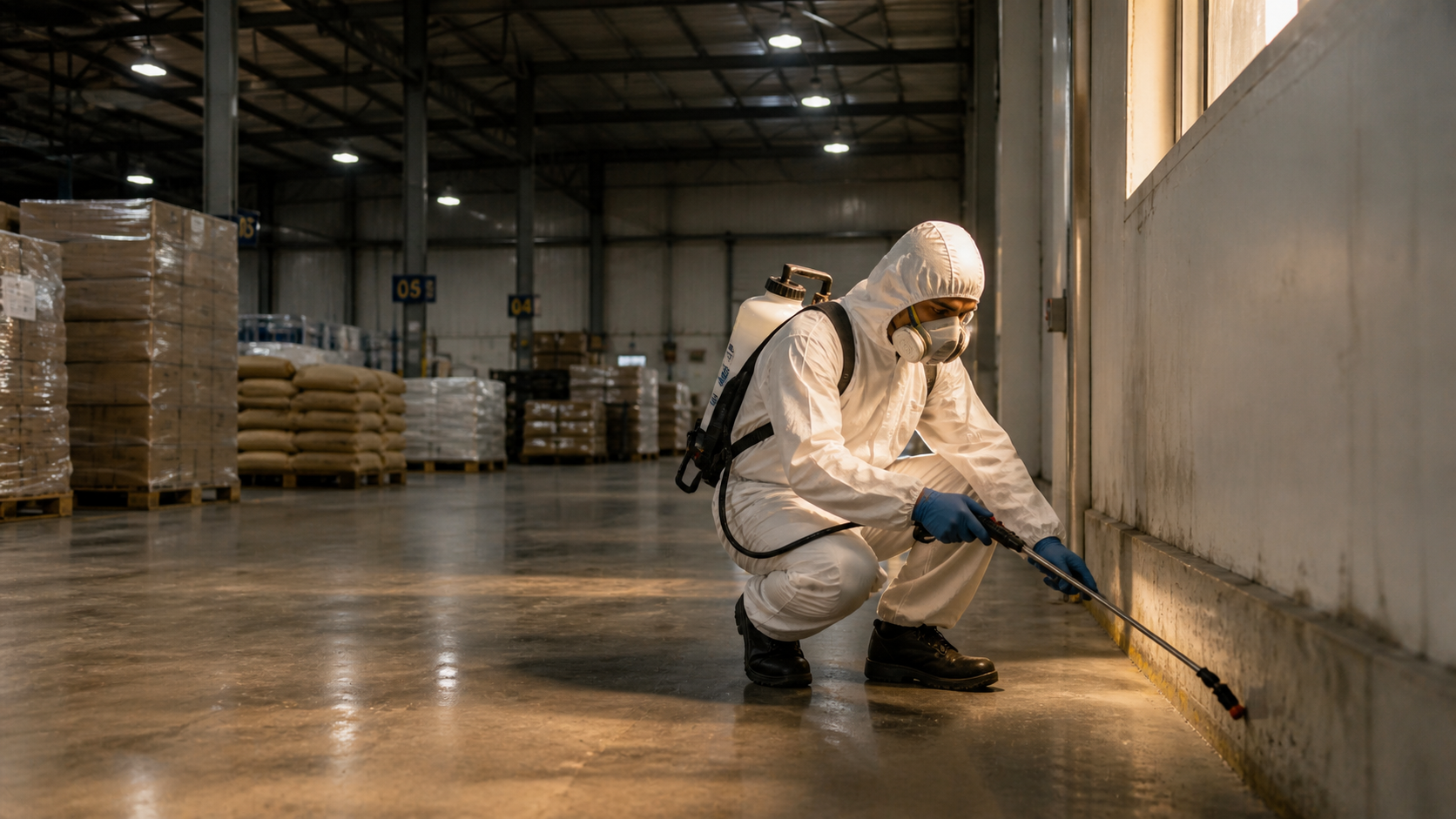
A fogging treatment at a 40,000 sq ft warehouse needs four techs. Your CRM lets you assign one. So the foreman texts the other three, writes notes in a WhatsApp group, and somehow everything hinges on his memory. When the customer calls back about a follow-up, nobody knows who did what.
Instead of four tools that don’t talk to each other, one system where the enquiry, the contract, the visit, the chemical use, the invoice, the IRN, and the renewal all share a single record. What you lose is the reconciliation tax. What you gain is the afternoon back.
Not a generic feature list. The six capabilities that most pest operators call out within 15 minutes of a demo.
Warehouse fogging, hospital fumigation, food-plant deep cleans — assign up to 10 technicians to one visit record. Track who actually completed it separately. No WhatsApp group of record.
Every chemical applied at a customer site links back to the specific batch it came from, oldest-first. When a food-plant auditor asks which batch of Imidacloprid was used at DMart Koregaon on 14 March, you answer from one screen — not from last year’s WhatsApp.
Insects, rodents, birds, and other categories each have their own structured fields. A cockroach infestation captures different data from a pigeon-nesting job — so your reports can actually filter by pest type, not search free text.
After a service — whether an AMC visit or a one-off fumigation — issue a branded treatment certificate from an HTML template. Auto-inserts company header, technician, chemicals used. Food-safety auditors stop asking twice.
Your invoice to the client optionally prints the specific treatment method (e.g. ULV fogging + gel baiting) inline. Corporate procurement teams need this detail for their own audit; the toggle is a one-click flag on the invoice.
A restaurant chain with 12 outlets. A logistics company with 5 warehouses. Bill consolidated or per-site; schedule visits per-site; the contract stays a single record. No duplicating master data across sites.
Material issued to a technician for a specific visit decrements warehouse stock at issue time. Each application records which purchase batch it came from via FIFO allocation. For food-plant audits and any regulatory review, every chemical applied traces back to its source batch — without reconstructing from WhatsApp or paper logs.
Name your teams. Register your vehicles. Picking a crew on a visit auto-fills the team’s members and pre-binds the vehicle. Especially valuable when a single contract covers multiple sites that get rotated across teams — your dispatch board stops being a WhatsApp ladder.
Fumigation as a specialised workflow inside pest control.
Container fumigation, warehouse fumigation, and export-cargo treatment ride on the same Upgear core — contracts, visits, chemicals, certificates, invoices — with the safety and customs documentation specific to fumigants modelled in.
- — Container fumigation certificates with chemical traceability — phosphine, methyl bromide, sulfuryl fluoride — chemical-specific safety protocols enforced at the visit-completion step.
- — Fumigation certificates auto-generated post-treatment with batch number, dosage, exposure time, and operator name embedded.
- — Customs documentation for export container fumigation — the certificate format that clears port-of-loading scrutiny.
- — GST e-invoicing on fumigation services with the relevant HSN codes pre-loaded.
- — WhatsApp notifications to logistics partners and consignees on treatment start, treatment end, and certificate issue.
From a walk-in enquiry at a food plant to the renewal reminder twelve months later.
One record, one database, seven transitions. Every step logs an audit entry. Every customer-facing step fires a WhatsApp template. None of it is manually bridged.
Every transition is captured in the audit trail — who, when, what changed — across almost every record in the product. Nothing in this flow requires a second tool.
The four receipts your commercial clients ask for.
Direct integration with the government’s e-invoicing portal. Every IRN generated, cancelled, and traceable. Above the ₹5 crore AATO threshold, e-invoicing has been mandatory since Oct 2024 — Upgear makes it non-eventful.
Technicians complete pest control visits on Upgear Mitra — chemical consumption per visit, before/after site photos, customer signature, optional OTP verification. The visit is closed in the customer’s compound, not back at the depot. See Mitra →
FIFO allocation at consumption time. Every millilitre of pesticide has a purchase order behind it. When a food-plant auditor asks which batch of Imidacloprid was used at DMart Koregaon on 14 March, you answer from one screen.
Tenant-editable HTML templates. Auto-populated with company header, technician, chemicals, and date. ISO audits, HACCP audits, HoReCa food-safety inspections — the certificate produces itself.
Every edit — who, when, what changed — captured automatically across almost every record. Per-tenant dedicated SQL database. When a hospital or government procurement team runs their InfoSec due-diligence checklist, this is the combination they’re looking for.
The platform has allowed us to reduce manual errors, maintain customer history, and ensure timely follow-ups — all in one centralized dashboard. What stands out is their responsive support team.
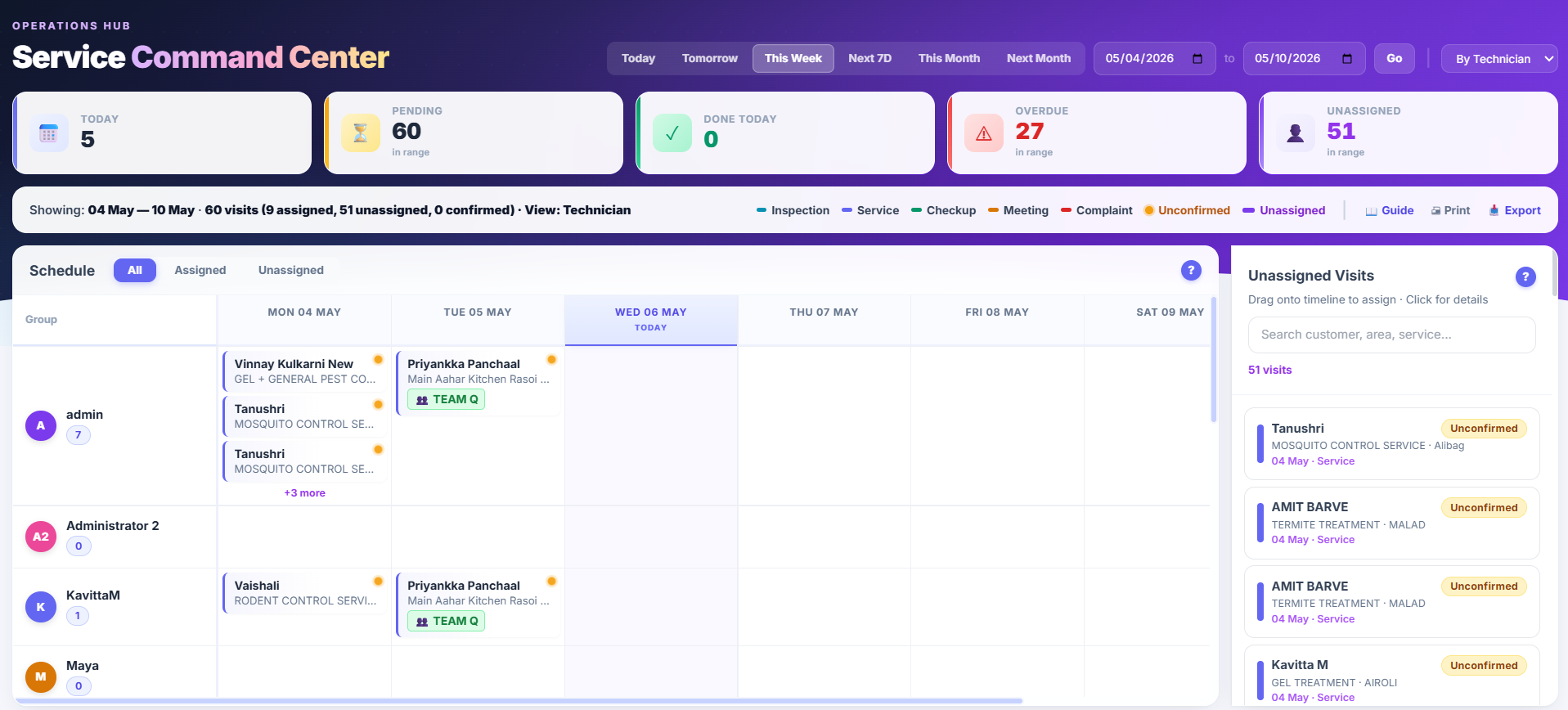
The Service Command Center is where your day starts.
Three phases. Typically 10–14 days. Parallel-run until you’re confident.
Most pest control operators come to Upgear with a messy hand-off between Excel, Tally, WhatsApp history, and sometimes PestVyapar or ServeWell. The migration plays to that: assess what you have, bulk-import with ready-made Excel templates, and run both systems in parallel for a week before cutting over.
We scope your current stack (CRM export, Tally data, attendance spreadsheet, WhatsApp history). You get back a mapping document showing where each field lands in Upgear.
We run the bulk-import templates against your files — customers, contracts, visit schedules, products, opening balance, opening stock, employees. Every row is validated; failed rows come back as an Excel for you to fix.
Both systems record new enquiries. You reconcile daily. When you’re confident, we cut over. No all-or-nothing risk.
Core covers pest control end to end. Photo Attendance is the one addon most operators add.
- ✓ GST e-invoice (IRN) direct to government portal
- ✓ Multi-company (separate GSTINs)
- ✓ 49 dashboards · 11 transactional WhatsApp events
- ✓ Free assisted migration · Data export on cancel
Selfie check-in/out with on-premises face match. Supervisor dashboard shows every photo with Match / Mismatch / First-time enrolment / No clear face — approve or reject with a reason. Rejected photos excluded from attendance reports.
Food-plant and hospital clients increasingly require biometric-verified attendance for vendor staff on site. Photo Attendance runs face recognition on your own server (no cloud API bill) and feeds the verified check-in directly into payroll.
The questions pest control operators actually ask.
See your pest control business running in Upgear, on your own data.
30-minute demo, founder-led. Bring a sample export from your current stack — we’ll load customer, contract, and chemical records into Upgear during the call and show you the Thursday-afternoon version of your operation.