Cleaning contracts don’t behave like break-fix jobs. Your CRM should stop pretending they do.
Recurring. Multi-site. Shift-based. Supervisor-signed. Your software needs to understand that a housekeeping contract is a fourteen-site monthly rhythm, not a ticket. Upgear is the Business Operating System designed for commercial cleaning operators.

Four problems generic CRMs were never built to solve.
These are the four highest-friction moments a cleaning operator we talk to describes within the first fifteen minutes. If your ops manager is holding the operation together with an Excel, a WhatsApp group, and a paper attendance register, each of the below probably happened this week.
A corporate client signs a ₹12 lakh/yr housekeeping contract across 14 office floors in two cities. Each floor needs a morning and evening shift; each shift needs supervisor sign-off. Today this lives in an Excel your ops manager updates by phone, and you find out someone didn’t show up when the client’s admin rings you at 11am.
The contract bills ₹220 per shift, per site, pro-rated for missed shifts. Your billing person reconciles attendance sheets, WhatsApp photos, and a supervisor’s WhatsApp message into a monthly invoice. It takes three days and still misses two shifts. The client notices before you do.
Your attendance register has five thumb-prints and nineteen ticks. You’ve lost three large commercial contracts to a competitor who can prove — with photos, with GPS, with a face match — that their staff were physically on site. You’ve priced in a ₹18,000/month attrition-and-rework buffer. The real number is probably higher.
Your biggest client requires ISO 9001 compliance on their vendor. The auditor wants “records of all supervisor inspections in the last 12 months, with dates, findings, and corrective actions.” You have WhatsApp screenshots and an accordion of paper checklists. The audit burns three people for two weeks. You pass, barely.
A contract with 14 sites becomes one record. Shifts become scheduled visits. Attendance becomes auditable. The monthly invoice assembles itself with the IRN already generated. What was three people’s Thursday becomes a supervisor signing on their phone between sites.
Six capabilities that shift the contract-to-invoice loop from “reconcile-then-bill” to “bill-from-record.”
A cleaning contract with 14 office floors lives as one contract in Upgear, with a site row per building. Visits are scheduled per-site. Billing can be consolidated or per-site. The contract remains a single source of truth for pricing and renewal.
Pre-schedule 12 months of morning + evening shifts across 14 sites by uploading a single Excel. Each shift becomes a Visit record. Supervisor marks completion; attendance and billing tie to it automatically.
Supervisors and cleaning crew use Upgear Mitra for shift check-in, site coverage, and completion sign-off. One app for a team that moves between 5 sites in a shift. See the Mitra workflow →
Photo Attendance addon: face recognition runs on your own server (no cloud API bills). Mismatches go to a supervisor-review queue. Rejected check-ins auto-excluded from payroll. This is how you show a commercial client their vendor’s staff were actually on site.
Branded certificate per visit, per site, dated, with supervisor and staff on it. Printable; emailable; WhatsApp-able. Commercial clients use these for their own audit trail and ISO renewals; you stop recreating them in Word.
You operate as two legal entities for two city contracts? Multi-company is in Core — separate GSTINs, separate P&Ls, consolidated reporting. The IRN is generated directly with the government portal. No ClearTax layer to copy-paste between.
A client logs a complaint: “Thursday evening shift didn’t empty the third-floor bins.” The complaint binds to site, contract, date, visit. Resolution status and root cause live on the record; a Complaints dashboard surfaces repeat offenders. This is what corporate procurement audits before contract renewal.
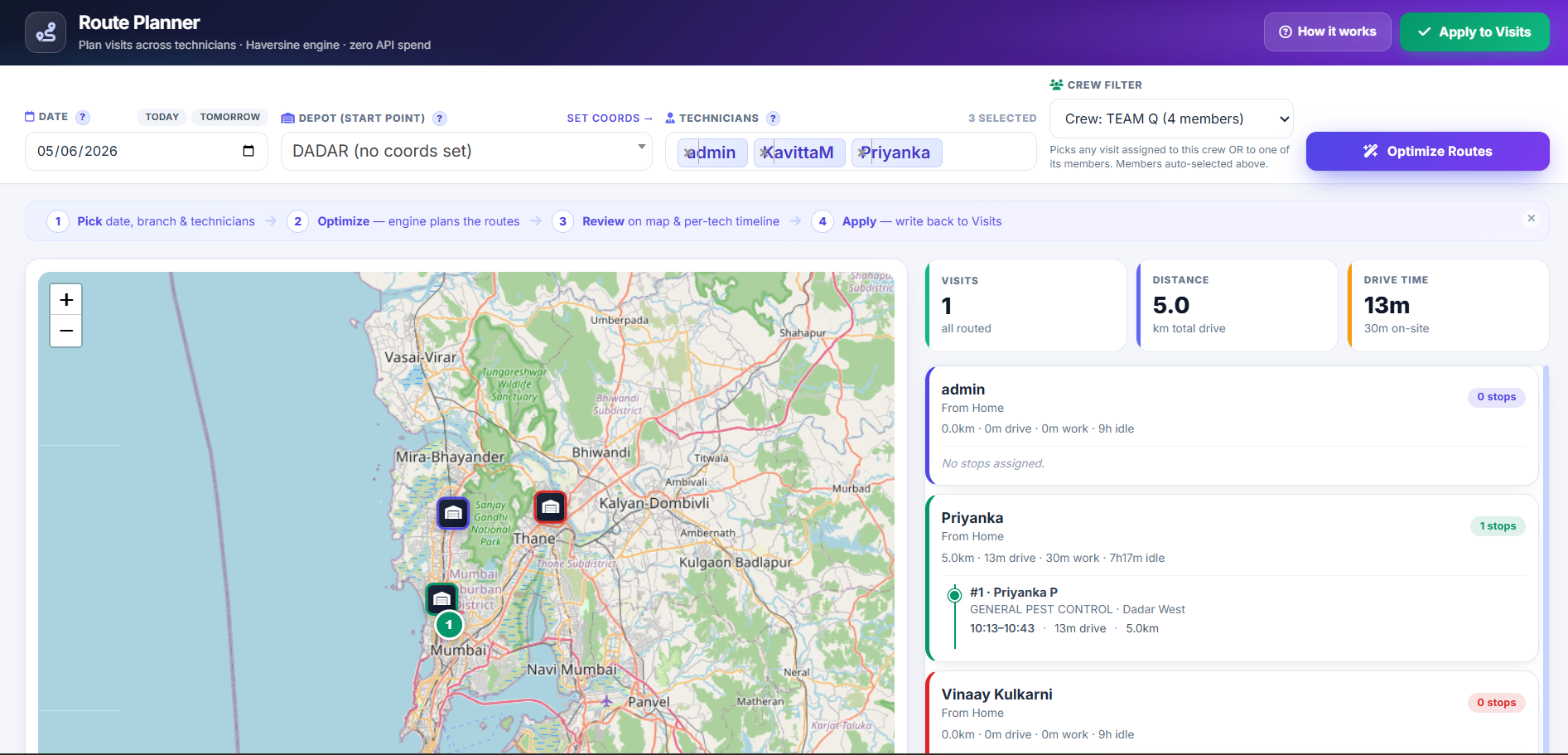
Cleaning firms with multi-site contracts and vehicle fleets benefit from crew + vehicle masters and route-optimized day plans. Pick a crew, pick a vehicle (or let the default kick in), and the day’s visits order themselves geographically — the optimizer respects working-hour packing and skill match. Routing runs in-process; no Google Maps API costs.
Cleaning firms exporting services to overseas accounts can invoice in foreign currency with rate-of-day preservation. Ten currencies are seeded (INR, USD, EUR, GBP, AED, SGD, AUD, CAD, JPY, CNY); per-transaction currency on Invoice, Voucher, Credit Note, Debit Note, and Purchase. Historical transactions stay valued at the rate they were created at, not today’s rate.
From a corporate RFP to the monthly per-site invoice, inside one record.
A 14-site, two-shift housekeeping contract is one Upgear record with fourteen site children. The visit schedule is bulk-imported from a single Excel. Attendance feeds payroll; visits feed billing; billing feeds e-invoicing. No separate tool in any transition.
Every shift mark, every amendment, every invoice edit is captured in the audit trail — so the monthly reconciliation call with the client takes ten minutes, not ten emails.
The four receipts your corporate clients ask for.
Direct integration with the government's e-invoicing portal — IRN generation, cancellation, and reporting all live inside your invoice. Monthly closing includes the IRN step, not a separate one.
Every shift is a Visit. Every Visit can have completion photos, supervisor sign-off, and a branded certificate. Your corporate client gets the evidence they need for their own audit; you stop producing them in Word.
Treatment certificates, complaint trails with root-cause tagging, inspection records — the underlying shape of the data matches what ISO 9001, HACCP, and HoReCa audits look for. Your auditor still audits; you stop assembling.
Every edit to a record — who, when, what changed — is captured automatically across the product. Your tenant runs on its own dedicated database, isolated from every other customer. When your corporate client’s InfoSec team runs their vendor-risk checklist, those two lines answer most of it.
Multi-site contracts plan their own day.
Three phases. Typically 10–14 days. Your operation runs both systems until you’re ready.
Most cleaning operators arrive with a messy mix — supervisor WhatsApp groups, paper attendance registers, an accountant’s Tally, and maybe a one-page CRM. We don’t ask you to tidy that first. Assess what you have, bulk-import employees, sites, customers, visit schedules and contracts through ready-made Excel templates, run parallel for a week.
We scope your current stack (CRM export, Tally data, attendance spreadsheet, WhatsApp history). You get back a mapping document showing where each field lands in Upgear.
We run the bulk-import templates against your files — customers, contracts, visit schedules, products, opening balance, opening stock, employees. Every row is validated; failed rows come back as an Excel for you to fix.
Both systems record new enquiries. You reconcile daily. When you’re confident, we cut over. No all-or-nothing risk.
Core covers the contract-to-invoice loop. The one addon most cleaning operators add is WhatsApp Marketing.
- ✓ GST e-invoice (IRN) direct to government portal
- ✓ Multi-company (separate GSTINs)
- ✓ 49 dashboards · 11 transactional WhatsApp events
- ✓ Free assisted migration · Data export on cancel
Beyond transactional messages, run marketing campaigns with revenue attribution. See which broadcast turned into which invoice.
Cleaning customers are won by referral and by competitive RFP campaigns. WhatsApp Marketing with closed-loop ROI attribution tracks which campaigns actually became signed contracts — not just delivered / read vanity numbers.
The questions cleaning operators actually ask.
See your cleaning operation running in Upgear, on your own data.
30-minute demo, founder-led. Bring one of your corporate cleaning contracts and an attendance sheet — we’ll build the same setup in Upgear during the call, show you where the invoicing loop closes.