Pest Control Software, built for Indian operators.
One platform for enquiries, contracts, GPS-tracked visits, chemical traceability, GST e-invoicing, and WhatsApp automation. No spreadsheets. No separate compliance tools. Built from the first line of code around how Indian pest control operators actually run — AMC contracts, food-plant audit evidence, multi-technician fumigations, and the reconciliation tax generic CRMs keep hiding.

A real pest control operation is not a break-fix ticket queue.
Indian pest control businesses run on AMC contracts, multi-site commercial relationships, and technicians who spend their days in the field rather than at a desk. Generic field-service CRMs treat a pest control visit as a ticket to close — which gets the sequence wrong. The contract is the unit; visits are scheduled against it; chemical batches are allocated per visit; invoices flow out of completion; renewals fire 30 days before expiry. Pest control software that doesn’t model this sequence forces the operator to hold it together in Excel.
A second structural mismatch: food-plant, hospital, and hotel-chain customers increasingly require audit-grade evidence on every visit. Batch number of the chemical applied, who applied it, when, at which site, with what dosage. If the pest control software can’t produce that trace in thirty seconds, the operator loses the contract at vendor-renewal time. Excel can’t produce it cleanly. WhatsApp groups can’t produce it at all.
Third: WhatsApp isn’t a marketing channel for Indian pest control — it’s the primary customer medium. Booking confirmations, visit reminders, invoice sharing, renewal follow-ups, Google-review asks all run there. Software that bolts on a separate WhatsApp marketing tool adds a reconciliation tax. Upgear sends transactional WhatsApp from inside the platform; the tax goes away.
Fourth: GST compliance. Above ₹5 crore AATO, e-invoicing has been mandatory since October 2024. Most global field-service CRMs don’t handle e-invoice (IRN) generation natively — they expect a ClearTax-style adapter layer. Pest control software designed for Indian operators should have the IRN integration in the base tier, not as a paid add-on. Upgear does.
Six capabilities that cover the whole pest control operation.
Capture enquiries from WhatsApp, forms, or walk-ins. Build quotations in minutes with dual-tax and discount modes. Issue multi-site AMC contracts with up to 12 billing tranches. Customer self-serve acceptance by signed link — no DocuSign bill.
Sales & Pipeline pillar →Assign up to ten technicians to a single warehouse fumigation or hospital deep-clean. Live GPS map shows every tech on one screen, updated every minute. Route tracker replays any day on demand when completion claims need verification.
Field Operations pillar →Every drum enters at the purchase-order stage with batch number, manufacturing date, and expiry. Every application at a customer site links back to the specific batch, oldest-first. Food-plant and hospital auditors get the trace they ask for in 30 seconds.
Chemical Traceability capability →Every qualifying invoice generates its IRN at creation, directly with the government e-invoicing portal on your own GSTIN credentials. No ClearTax subscription. No per-invoice copy-paste. GSTR B2B, B2CL, B2CS all generate natively inside the platform.
GST e-invoice capability →Transactional events fire automatically on every record lifecycle — enquiry, quote, contract, invoice, visit, renewal. Provider-neutral: Gupshup, Interakt, Wati, AiSensy, Kaleyra, MSG91 and most others plug in without re-integration.
WhatsApp capability →Branded treatment certificate per visit, per site, with supervisor signature, technician details, and batch numbers applied. Printable, emailable, WhatsApp-able. Food-safety audits, ISO renewals, hospital procurement reviews all use these as evidence.
Pest control industry page →Material issued to a technician for a specific visit decrements warehouse stock at issue time. Each application records which purchase batch it came from via FIFO allocation. Expiry travels across stock transfers. The chemicals-by-batch evidence base for state pest-control licence reviews and food-plant audits.
Field Operations pillar →Name your technician teams. Register the vehicles they drive. Picking a crew on a visit auto-assigns the team’s lead and members; pre-binding a vehicle to a crew also pre-fills it on dispatch. Especially valuable for multi-site contracts rotated across teams.
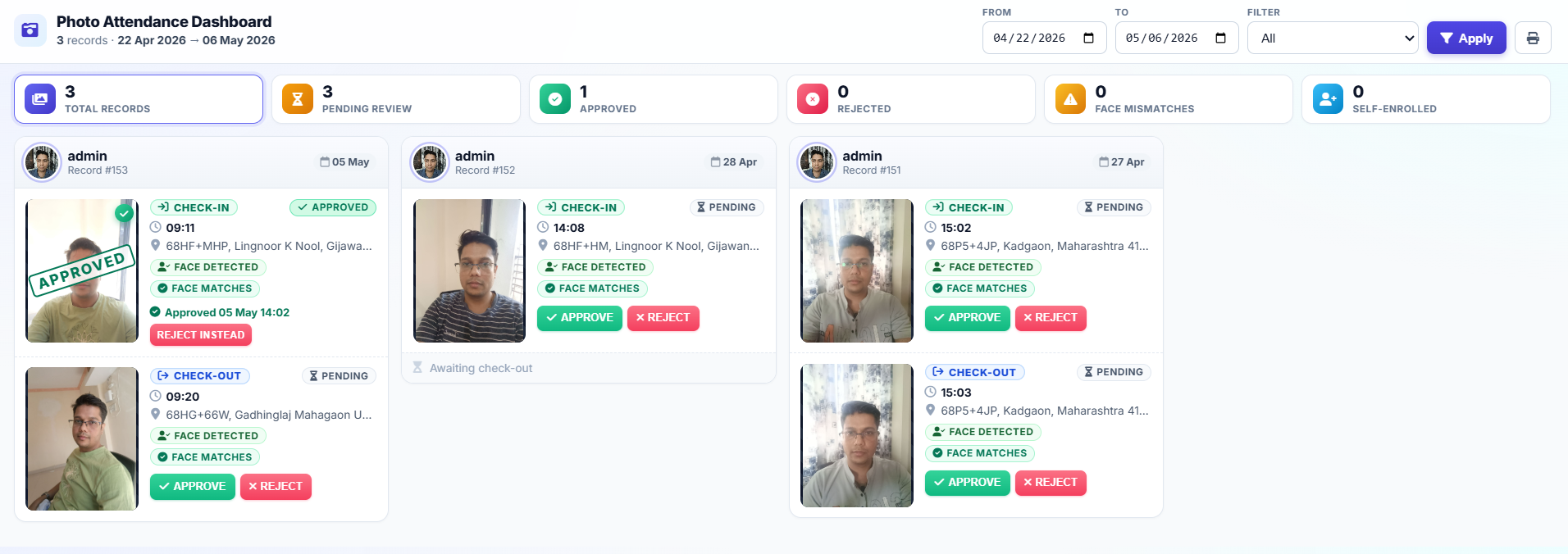
Field Operations pillar →Field staff clock in and out with a selfie. The system scores each photo against the employee’s profile, returning Match / Mismatch / First-time enrolment / No clear face. Supervisors approve or reject from a dashboard with a quick-reason picker. Runs entirely on-premises — no cloud face-recognition costs. Tailored-pricing addon — quoted on the demo.
Workforce & Payroll pillar →Trial Balance, Trading Account, Profit & Loss, Balance Sheet, Cash Flow, and Bank/Cash Reconciliation — all generate natively from your voucher ledger. No separate Tally subscription, no separate Zoho Books. Field operations and accountant-grade close-of-books in one product.
Finance & Compliance pillar →Dispatchers see an interactive route-planner that orders the day’s visits for a technician by geographic proximity. Respects working-hour packing and skill match — a technician marked for “Bird Control” only gets bird-control visits. Routing runs in-process; no Google Maps API costs.
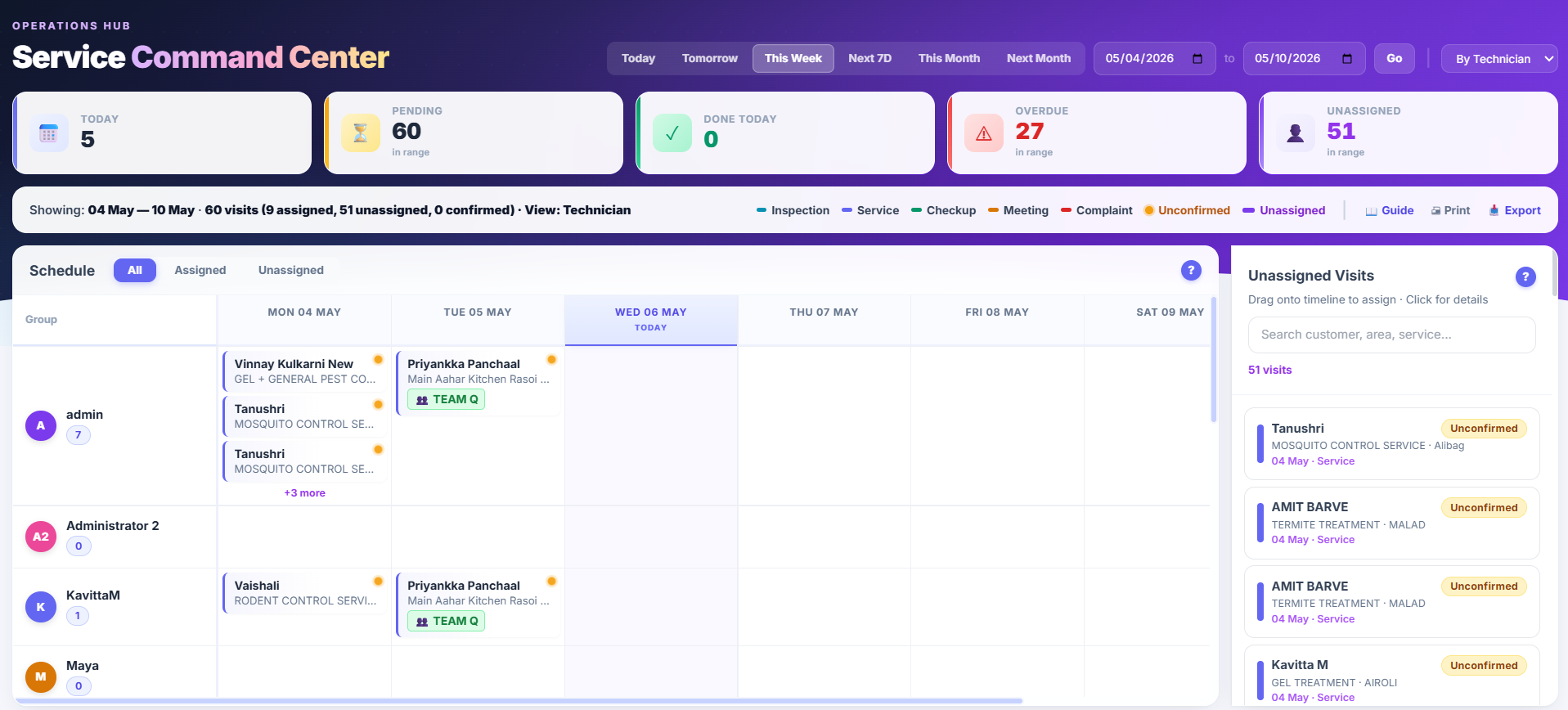
Field Operations pillar →The Service Command Center is where your day starts.
A localisation layer is not the same as a product designed for you.
Most global field-service CRMs serve Indian pest control operators through a regional-settings wrapper around a product designed for North American or European businesses. A currency dropdown, a tax-calculation plugin, a timezone option. That works for simple cases and breaks for everything that touches real Indian operations: GST e-invoicing, multi-company with separate GSTINs, HSN/SAC invoice rounding, UPI payment modes, Hindi/Marathi voice input for field technicians, AMC contract structures with quarterly tranches, food-plant audit evidence requirements.
Upgear is India-native in the sense that GST is the spine of how invoices, vouchers, and reports are modelled — not a plugin bolted on. WhatsApp is the primary customer touchpoint the product is built around. Multi-company with separate GSTINs ships in Core because Indian pest control operators routinely run multiple legal entities. Our AI Copilot handles voice input in Hindi, Marathi, and Hinglish code-switching because that’s how field technicians actually talk.
One more thing that matters for commercial buyers: every Upgear customer runs on their own dedicated SQL database — not a shared multi-tenant pool. This is the single line InfoSec teams at hospitals, food plants, and listed companies ask for when reviewing a pest control vendor’s software. Shared-schema multi-tenancy — the norm for global SaaS — usually fails that review.
Upgear Core pricing is tailored by association membership, geography, and team size — quoted on the demo. Three directional bands. Nothing hidden.
For firms ranging from solo pest control operators to multi-branch groups. GST e-invoice, multi-company, 49 dashboards, WhatsApp lifecycle automation, and free assisted migration all included in Core. Three optional addons available.
The platform has allowed us to reduce manual errors, maintain customer history, and ensure timely follow-ups — all in one centralized dashboard. What stands out is their responsive support team.
Upgear vs. the pest control software alternatives operators actually consider.
Five rows on the capabilities that matter most at commercial / compliance-heavy scale. Follow the links for the full honest comparisons — each one acknowledges where the competitor wins too.
Ten to fourteen days. Parallel-run until you’re confident.
Most pest control operators come to Upgear from some mix of Excel, Tally, WhatsApp history, and sometimes PestVyapar or ServeWell CRM. The migration process plays to that reality. Days 1–3: we scope your current stack and map fields. Days 4–8: bulk-import customers, contracts, visit schedules, employees, opening balance, opening stock — ready-made Excel templates cover every entity. Days 9–14: parallel-run, where new enquiries flow into Upgear while your old tool stays available for reference.
Around day 12, most operators notice the cost of running two systems and decide to cut over. Assisted migration is included in Core — no additional fee. Your team commits a few hours of field-mapping review and attends one kickoff and one cutover call. Operations continue uninterrupted throughout the migration.
What buyers ask before choosing pest control software.
See Upgear running on your pest control operation in 30 minutes.
30-minute founder-led demo. Bring one of your live customer records, a recent invoice, and a technician visit from this week. We'll reconstruct the whole flow in Upgear during the call — enquiry, quote, contract, visit, invoice, renewal — on your actual data.